
Prime Minister Narendra Modi has said that India's economic growth is a 'natural by-product' of his nine-year-old government's political stability, as he expressed optimism that it will be a developed nation by 2047 with 'corruption, casteism and communalism' having no place in our national life.

The opposition Peoples Democratic Party on Tuesday urged the Prime Minister, Dr. Manmohan Singh to convene a round table conference to start the dialogue process.

Immediately after Modi delivered his speech, Omar merely tweeted "finally" but, in a subsequent tweet, voiced his disagreement with Modi's view.
It also said jihadi organisations should have to be associated with the dialogue process between Pakistan and India.
Pakistan President Pervez Musharraf expressed his readiness to attend a round table on Kashmir in Srinagar or New Delhi along with Prime Minister Manmohan Singh for finding a solution to vexed issues.
Lee Hamilton, vice-chairman of the 9/11 Commission and now president of the prestigious Washington-based think tank, Woodrow Wilson Center for Scholars, has argued it is in US's interest to resolve the Kashmir issue, which he said would require tough diplomacy. "We certainly need to work with Pakistan and India to resolve the Kashmir problem. The United States can't resolve that, but we can encourage the two parties to address it," Hamilton said.
Pakistan was always sincere in resolving the Kashmir issue, but India had to give up its 'stubbornness', a Pakistan minister said.
It seems that realisation has dawned, at last, in New Delhi that the ground situation in Jammu and Kashmir has become a national crisis. The government is waking up to connect to the state, which is under the wave of violence, notes Sheela Bhatt.
Former All Party Hurriyat Conference Chairman Abdul Gani Bhatt has welcomed US Secretary of State Hillary Clinton's viewpoint that the Kashmir issue must be looked at from a fresh angle that may lead to finding an amicable solution to the problem.

"Talks are the only option," Mehbooba said. "How long can you have a confrontation?"
India on Wednesday sent a high-level 12-member Parliamentary delegation led by Jammu and Kashmir Pradesh Congress chief Professor Saifuddin Soz to Pakistan to look for a political solution to the Kashmir tangle. This the first visit of an Indian delegation to Islamabad after United States' forces smoked out Osama bin Laden from his hideout in Pakistan's cantonment town of Abbottabad.

During his visit, Rajnath will review the situation and may hold talks with cross section of people.
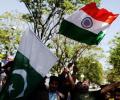
India suggested that Pakistan should refrain from using the Right of Reply and instead "use the right of introspection" to think about the direction in which the country is moving.
For a long-term solution to the Kashmir problem, there is no substitute to opening a mass debate with representatives of all regions of the state and not just the valley, says Colonel Anil Athale (retd).

'War cannot resolve problems. So wisdom is to resolve diplomatically.'
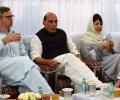
Singh appealed to the people of Jammu and Kashmir to come forward for bringing back peace in the state.

While the government interlocutor for J&K may be tasked with holding talks with 'all stakeholders', the central government is singing a very different tune in the Supreme Court, Aditi Phadnis points out.

Sharma will decide whom he wants to hold talks with, Singh said when asked whether he would have dialogue with the Hurriyat Conference.

In a significant move, Kashmiri separatist leaders on Sunday decided to convene a meeting of all stakeholders on Tuesday to decide the future course of the nearly four-month-long shutdown in the Valley.

Chastened by the Kargil conflict, Pervez Musharraf will be remembered for gradually lowering the profile of terrorism and seeking a realistically negotiated settlement to the issue of Jammu and Kashmir, notes Ambassador G Parthasarathy, who served as India's high commissioner to Pakistan when Musharraf seized power in a coup in October 1999.

Striking a note different from the established line, Pakistan Foreign Minister Hina Rabbani Khar has spoken of the need for an "out-of-the box" solution to the Kashmir issue, saying that militancy would not help in resolving the long-standing dispute with India.
"Whatever the solution is, certainly the people of the region need to have a voice in it, however the two sides choose to resolve it," McCormack added.

Sending a strong message to Pakistan, Rajnath also said the neighbouring country should change its attitude and approach towards Kashmir.
Asserting that India and Pakistan have to step back from their "maximalist" approach on Kashmir, Pakistan President Pervez Musharraf said the leaders of the two countries should be 'bold enough' to strike a decision on the issue

'Everyone has to take some step in solving this deadlock -- civil society, separatist leaders, the government.'
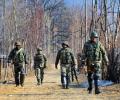
'Viewed militarily, the cease-fire puts the brakes for sure on the hard fought dominance that our security forces have achieved.' 'The ensuing weeks will witness their losing ground to the terrorists,' fears Brigadier S K Chatterji (retd).

'The more harder India pushes its nationalism on to its population, the further away we send Kashmiris.' 'We should understand that the unrest in that state cannot be solved by demonetisation. There are much deeper causes,' says Aakar Patel.

'Indira Gandhi and P N Haksar did not want Pakistan to leave as an embittered foe hell-bent on taking revenge for being humiliated so comprehensively.'

Sharif raises Kashmir issue at UNGA, renews plebiscite demand.
Supporting the India-Pakistan talks and peace process, he said dialogue was imperative but there should be the world community's involvement at a certain level to reach a solution acceptable to all the parties concerned.
Strategic affairs specialist Ashley Tellis believes the November 26 terror attacks on Mumbai has given birth to the "misguided notion" that a resolution of the Kashmir dispute is imperative to rein in terrorism in South Asia, and that this should be the priority of the proposed special envoy to the region.

If military power is all it would take to finish the menace of an awful terrorist organisation like Hamas, how come five Israeli wars in Gaza since 2003 have failed to do so? asks Shekhar Gupta.

However, the pellet guns will continue to be used as the last resort in the non-lethal category.

The "eyeball to eyeball" deployment and the dynamic internal security situation in the JK make Northern Command the most unique theatre.

The editorial said, "Such posturing will only doom Kashmir to a deadly spiral, where more brutal military tactics will feed more despair and more militancy".
The solution to the Kashmir problem does not lie in India speaking to Pakistan; it does not lie in the Indian government speaking to the separatists; it lies in the Kashmiris talking to their inner selves. They need to trace their history to include their rich cultural heritage of Hindu Saivism and Sufi mysticism. Only then will Kashmiris be at peace with themselves, says Vivek Gumaste.

Immediately after exploding, it emits gas which causes breathing difficulty and irritation in eyes.

"Read my lips," said Richard Holbrooke, special US representative to Afghanistan and Pakistan, "I am not working on that problem," when asked by a Pakistani journalist if the Obama administration was 'serious to appoint any adviser to resolve this issue,' since as the latter contended, "We all know that deep down, there is no solution of Afghanistan and the South Asia problem, without resolving the Kashmir issue that is controlled by Indian government."
 © 2026 Rediff.com - Advertise with us - Disclaimer - Privacy Policy - Sitemap - Feedback - About us - Terms of use - Grievances